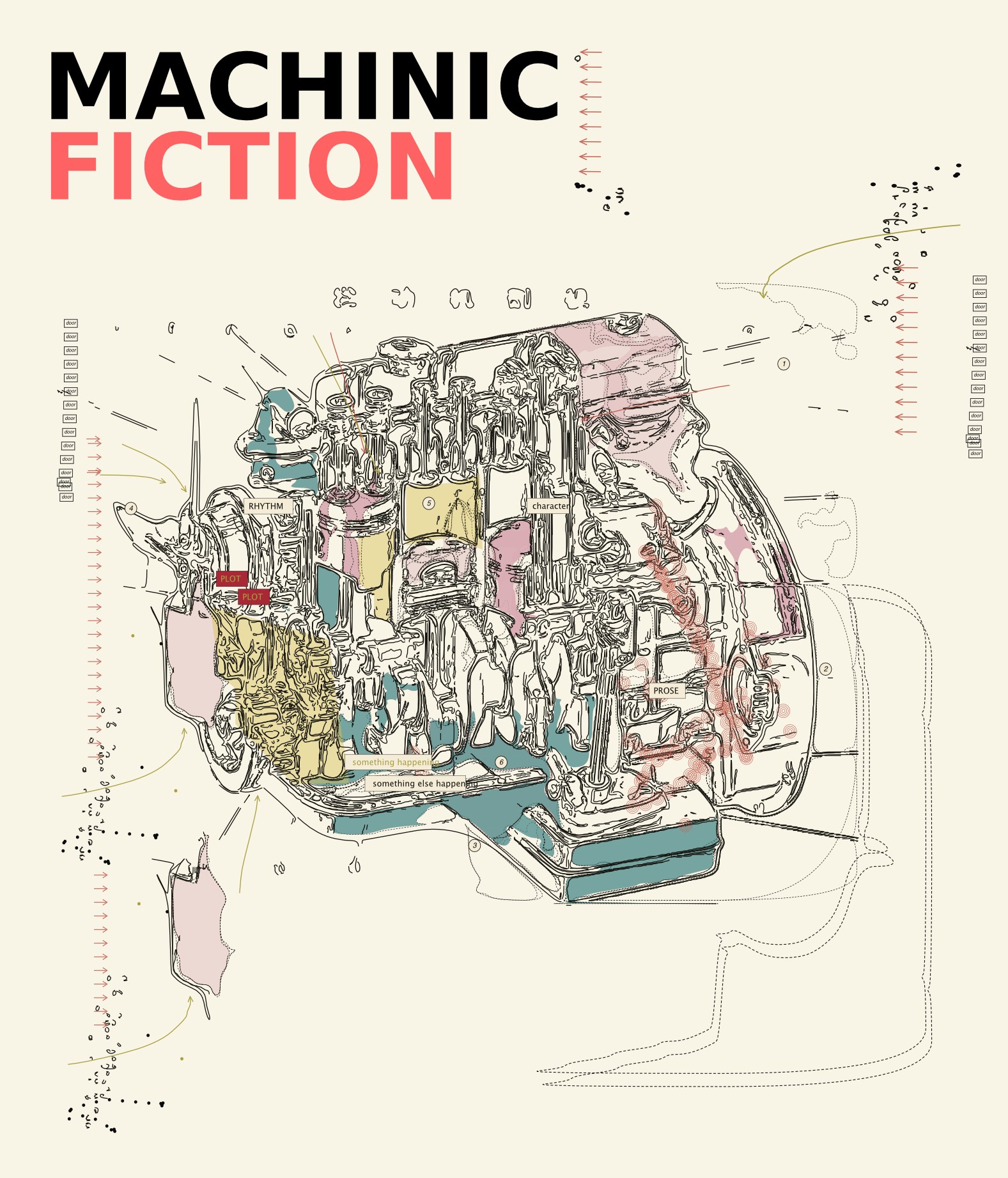
Machinic Fiction: a hand-drawn machine

Research creation

The Fiction Machine

Year
2026
Medium
Multi-agent fiction system, writing
Made for
The Unslop Fiction Contest (Hyperstition)
Shown
AI Vancouver Meetup, 2026 · 4S panels, Toronto 2026 and Seattle 2025
Published
Essays on Substack

I wanted the system itself to be a kind of artwork. The design of the system becomes the site of authorship. The authorship just moved upstream — from the sentences themselves to creating the conditions for the sentences to happen.

The talk

Building an Anti-Slop Machine: What AI Reveals About Creative Processing. AI Vancouver Meetup, 2026. Watch on YouTube →

Statement

This research began with a provocation in the form of a contest: AI fiction sucks. What is your theory about how to fix it? The rule was that you could not touch the final output. All you could do was enter a tweet-length story seed and press go.

My answer to the question of why AI fiction sucks is because it is actually pretty good. It works. It is fine. That’s it. Death by fine-ness.

In AI slop, nothing is load-bearing enough to resist replacement.

The system

World
What the story cares about. All unslop stories are deeply interested in AI and the impacts these technologies have on human beings.
Corpus
What the story remembers. Theory that accumulates each pass of the system, and my own writing indexed into chunks that provide voice for the prose.
Seed
The only human entry once the system is designed. Two sentences, always a situation with a person being impacted by a technology in some way.
Agents
Eight agents in the system, each designed as a different way of paying attention.
Processes
Search, deposit, build, interview, draft, annotate, revise, cut. Each process is small and constrained and builds on specific previous outputs.
Outputs
The traces of each process. Nothing is thrown away. Every search, deposit, character interview, annotation, and editorial letter is written to a folder, so I can read the reasoning trail of any story.
Drafts
The changing story. Three drafts, each made by a different operation.

A story

SeedThe custodian of a regional archive is told the AI will preserve everything. She begins, quietly, to misfile documents — testing what counts as preservation when nothing can be lost.

From the finished story, The Hand That Will Not Lift

The contract was signed in March. Margit had recommended it. She had recommended it in writing, with footnotes, three of them flagging her own reservations, which she had then in person walked the board through with the precision she reserved for things she wanted to be on the record as having said. The reservations were noted. The recommendation was adopted. The vendor representative — a woman named Carla, who had flown in from Minneapolis — shook her hand and said, We’re going to do right by you, Margit, and Margit corrected the pronunciation without smiling.

Talks, panels and writing